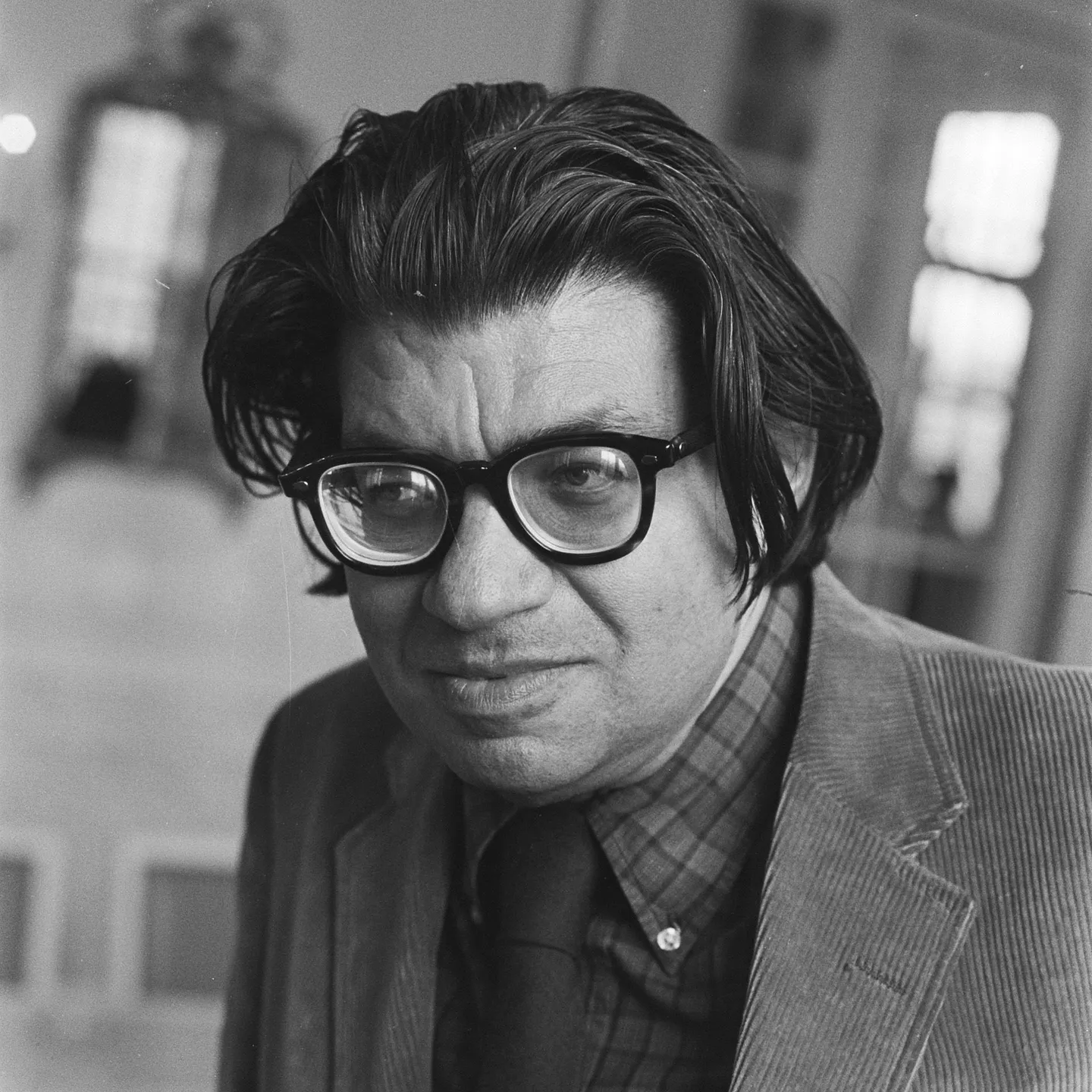
Biography
Morton Feldman (1926–1987) was one of the most distinctive American composers of the twentieth century: a maker of fragile, hovering sound-worlds; a central figure in the postwar New York avant-garde; and, in his later decades, the author of vast, quietly radical works that redefined musical time. Feldman’s music resists conventional drama. It unfolds as if heard at the edge of attention—soft, patient, and exquisitely detailed—yet it is underwritten by an exacting ear and a fierce aesthetic intelligence. His biography is inseparable from a cultural moment in which composers, painters, poets, and choreographers in New York were remaking the idea of what an artwork could be.
Early life and formative influences (1926–1950)
Morton Feldman was born in New York City on January 12, 1926, and grew up in a milieu shaped by immigrant life, urban modernity, and the intense cultural crosscurrents of the city. He began piano lessons early. By his late teens he was composing, but not with the conservatory-bound trajectory of many peers. Feldman’s path was comparatively oblique: he studied with teachers in and around New York and absorbed the modernist repertoire, yet he was drawn less to academic systems than to the living, experimental art of his immediate environment.
One crucial formative influence was the composer Wallingford Riegger, with whom Feldman studied in the 1940s. Riegger represented an American modernist lineage—tough-minded, anti-romantic, serious about craft—while still standing somewhat apart from European orthodoxies. Feldman also studied with Stefan Wolpe, a formidable and charismatic teacher whose background encompassed European modernism, political engagement, and an intense, almost combative insistence on musical material. Wolpe’s studio was an incubator of hard questions about structure, sound, and artistic responsibility. Feldman, however, was never the sort of student who would simply inherit a method. Even when learning in traditional ways, he was moving toward an aesthetic grounded in listening rather than doctrine.
From the beginning, Feldman’s sensibility aligned with what would later be called “anti-teleological” music: music that does not aim toward climaxes, that does not treat development as a moral imperative, and that refuses the narrative arc as a default. That orientation would become clearer once he entered the orbit of John Cage and the wider New York School, but its seeds were already present in his temperament: an attraction to the “present tense” of sound, and a suspicion of forms that seemed to coerce experience.
The Cage encounter and the New York School (1950s)
A defining event in Feldman’s life occurred in 1950, when he met John Cage after a concert at Carnegie Hall. The encounter quickly became a friendship and a catalytic artistic partnership. Cage was then advancing ideas that challenged the very foundations of compositional intention—chance operations, indeterminacy, a de-centering of the ego. For Feldman, Cage’s example did not provide a recipe so much as permission: permission to pursue a music of delicacy, unpredictability, and radical restraint.
Feldman soon became associated with the “New York School” of composers, a loose constellation that included Cage, Feldman, Earle Brown, and Christian Wolff. What unified them was not a single technique but a shared ecosystem: New York’s experimental scene, interdisciplinary collaborations, and especially a deep affinity with the contemporary visual arts.
This connection to painting was not a superficial influence in Feldman’s case. He formed enduring friendships with major Abstract Expressionist and post-Abstract Expressionist painters—artists for whom scale, surface, gesture, and the physicality of materials were central concerns. Feldman spent time in studios and at openings; he listened to painters talk about edge, density, texture, and proportion. He took these concepts seriously as analogues for musical thinking. The result was not “music about painting,” but music composed with a painterly mind: attentive to the grain of sound, to the way events sit in space, and to how a work’s overall field can be shaped without relying on conventional thematic development.
Early techniques: graphic notation and indeterminacy
In the early 1950s Feldman began to create scores that loosened the traditional control of rhythm and pitch. He produced a series of graphic notations—often grids or patterns indicating approximate registers, durations, or densities—inviting performers to realize the material with a degree of freedom. Works such as Projection pieces and Intersection pieces exemplify this period’s fascination with indeterminacy and with sound as a field rather than a line.
Yet Feldman’s relationship to indeterminacy was always personal and selective. Unlike Cage, who embraced chance as a philosophical stance, Feldman tended to use open forms as a means of arriving at a specific kind of listening: a music in which events appear unforced, where one does not feel the heavy hand of compositional “argument.” Even in his most open scores, Feldman was chasing a very particular atmosphere—soft attacks, sparse densities, and an uncanny sense of time suspended.
During this period he also began composing pieces that were notated more conventionally but that nonetheless departed sharply from mainstream modernism. The music often sits at low dynamic levels, with gentle, isolated sonorities and a reluctance to assert. Silence is not treated as empty space but as an active frame. Feldman’s early mature works show an instinct for what might be called “quiet precision”: writing that is understated in volume yet exacting in how it places sound.
Aesthetic commitments: sound, time, and scale
Feldman’s lasting contribution is as much aesthetic as technical. Several commitments recur throughout his career:
The primacy of timbre and sonority. Feldman treated sound-color as structural. Chords and intervals matter, but often as carriers of resonance, friction, or afterimage rather than as harmonic functions.
Non-developmental form. He resisted the common modernist imperative to “develop” an idea. In Feldman, repetition rarely means insistence; it means re-seeing, like returning to a color or texture under slightly altered light.
Soft dynamics and the ethics of listening. Feldman’s quiet is not a mannerism; it is a strategy that changes the listener’s relationship to time. Soft music forces attention without aggression and makes the room—breath, ambient sound, the decay of tones—part of the experience.
Scale as a perceptual problem. In his later years especially, Feldman wrote very long pieces. Their length is not about monumentality in the usual symphonic sense; it is about saturation and drift, the way perception itself changes over extended durations.
These commitments align him with certain painters and poets more than with many composers of his generation. Feldman’s work can feel less like a narrative and more like a surface one inhabits.
Mid-career consolidation and a turn toward exact notation (1960s–1970s)
As Feldman moved into the 1960s and 1970s, his notation became more precise, though the music remained elusive and understated. He did not abandon the insights of the earlier graphic period; he translated them into exacting written detail.
This is also the era in which Feldman became increasingly recognized in contemporary music circles, though he remained something of an outsider—neither a serialist nor a minimalist, and not easily captured by institutional categories. His music was performed by specialist ensembles and adventurous musicians. His collaborations and friendships remained strongly interdisciplinary; he maintained close ties with dance and the visual arts world.
Feldman also began teaching and took on more public roles in the musical community. His speaking and writing reveal a sharp, sometimes combative intellect: he could be skeptical of academicism, impatient with fashionable systems, and unwavering in his belief that composition begins with the ear, not with theory.
The late style: long duration and luminous surfaces (late 1970s–1987)
In the late 1970s Feldman entered the period many consider his artistic summit. He began writing works of unprecedented length—often an hour, two hours, or even longer—yet still in the delicate, quiet idiom that had characterized him for decades. Rather than expanding his music by adding overt drama, he expanded it by extending attention itself.
These late works frequently employ:
Patterns that repeat with slight alterations, producing a sensation of déjà vu without literal sameness.
Chordal writing that behaves like color fields, with small shifts in voicing and register.
A refined control of attack and decay, so that the resonance of instruments becomes a primary actor.
Among the most celebrated late compositions are Rothko Chapel (a landmark work for mixed ensemble and chorus associated with the spiritual, contemplative space in Houston), Triadic Memories (for solo piano, a foundational late work that explores memory and repetition), and the expansive string quartet String Quartet II, whose extreme duration stands as one of the most radical reimaginings of chamber music in the century. Works such as For Philip Guston and Crippled Symmetry further exemplify his late-period balance of scale and intimacy.
This music is sometimes described as “minimalist,” but that label is misleading. Feldman’s repetition is not motoric; it does not lock into a grid or pursue process in the manner of early minimalism. His surfaces are unstable, his rhythms often asymmetrical or quietly irregular, and his harmonic field is full of subtle friction. The effect is closer to wandering through a gallery of related canvases than to watching a machine unfold.
Personality, voice, and intellectual stance
Feldman’s persona—through interviews, lectures, and accounts from friends—was complex: witty, blunt, highly opinionated, and deeply loyal to the artists he admired. He could be skeptical of institutional prestige and impatient with what he perceived as compositional gimmickry. At the same time, he was intensely serious about craft and about the conditions that allow art to be made honestly.
His closeness with painters shaped not only his music but his way of speaking about it. He often used metaphors drawn from the studio: scale, touch, surface, “edge,” the difference between an image that is composed and one that is discovered. He was fascinated by how an artwork holds together when it refuses conventional coherence—how it remains compelling when it offers no narrative reward. For Feldman, the question was not “What does the piece do?” but “What does it allow to happen?”
Final years and death (1987)
Feldman continued composing at a high level until the end of his life. He died in 1987, leaving behind a body of work that—while never courting popularity—has exerted a profound influence on contemporary composition, performance practice, and listening culture.
In the decades since his death, Feldman’s music has steadily grown in stature. What once seemed eccentric—extreme quiet, lengthy durations, refusal of conventional argument—has come to be recognized as a rigorous alternative modernism: a disciplined art of attention.
Legacy and influence
Feldman’s impact can be traced in multiple directions:
Contemporary composition: Many composers have taken cues from his attention to timbre, his non-teleological forms, and his willingness to work at soft dynamic extremes.
Performance practice: Feldman demands a particular kind of virtuosity—control, patience, and sensitivity to decay. His work has helped cultivate generations of performers comfortable with slowness and with music that does not “announce” itself.
Interdisciplinary art: Feldman remains a key reference point for artists interested in the porous boundary between sound and visual experience, and for those who think of art as an environment rather than a statement.
His most distinctive legacy may be the redefinition of what musical intensity can be. In Feldman, intensity is not volume or speed; it is concentration.