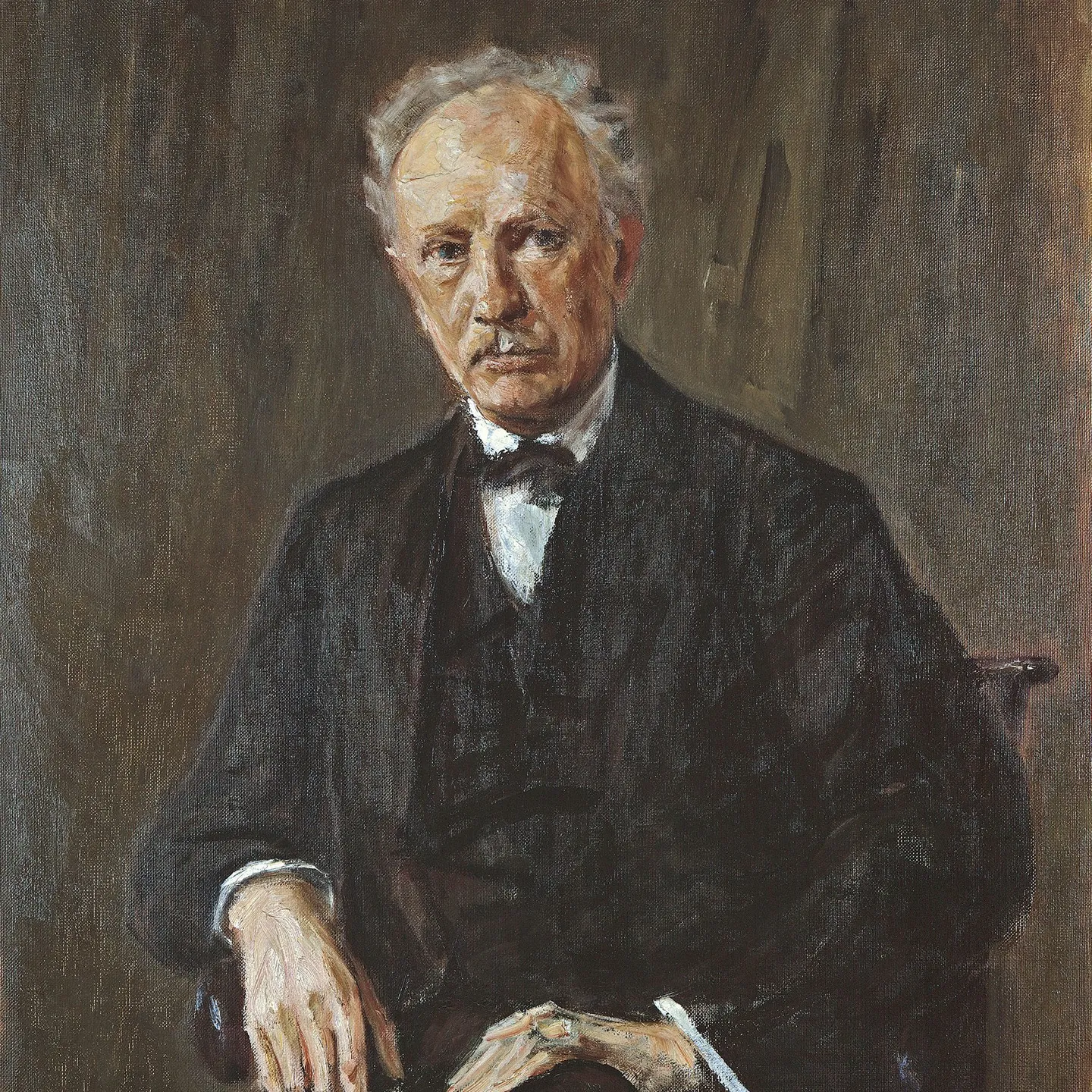
Biography
Richard Strauss was a famously private man, hiding his passion under a veneer of affability. Yet a clue to his temperament can be found in two great musical loves of his life. First is Wolfgang Amadeus Mozart, whose music was a benign influence as Strauss came to maturity in nineteenth-century Munich. Then there is Richard Wagner, whose example helped to liberate him from more conservative models.
Strauss was often caricatured for the extravagance of his orchestrations. But while his writing can be the most opulent of any late-Romantic composer, he was capable of supreme refinement. Even Strauss’s most lavishly scored symphonic poems and operas contain many of the effects of intimate chamber music. He also had a superb understanding of the female voice. This came from soprano Pauline de Ahna, who was his wife of 55 years.
Another unforgettable sound in Strauss’s works was nurtured by his father, Franz Strauss, principal French horn in the Munich Court Orchestra. He was a tremendous player, but conservative in his tastes. He led the horn section in the premieres of several of Wagner’s operas, giving perfect renditions of the solos in each. But when the orchestra stood to acknowledge Wagner’s work he remained seated in protest at the composer’s modernism.
Richard’s own cautious musical steps began when he discovered Johannes Brahms’s music in the early 1880s. As a young man he took many character-forming conducting posts, but one of these provided a seminal experience. At Weimar he conducted Wagner’s opera Tristan und Isolde for the first time. As he wrote to the composer’s widow Cosima Wagner in 1892: “It was the most wonderful day of my life.”
By then he had struck out on his own as a composer. He followed the prescriptions of Wagner’s disciple, the composer and violinist Alexander Ritter, to pursue the idea of the symphonic poem. His first major achievement in the genre, Don Juan, was a breath of brilliant, sensual fresh air when it appeared in 1889.
Another, Also sprach Zarathustra (1896), was an incandescent tribute to the poetry rather than the philosophy of Friedrich Nietzsche. Strauss’s love of contrasts continued with the metaphysics of Tod und Verklärung (1890) and the cheeky humour of Till Eulenspiegels lustige Streiche (1895).
Don Quixote (1897) pays homage to Cervantes’s comic knight, and was followed by the semi-autobiographical struggle of Ein Heldenleben (1898). Some see a streak of Bismarck-era grandiosity in Strauss’s music, but it is hard to credit in his suggestion that these two works be performed together.
One theory has it that the quality of Strauss’s symphonic poems declined as opera began to take centre stage. Yet performances and recordings of the staggeringly well-structured Symphonia domestica (1902–03) and the nature-worshipping Eine Alpensinfonie (1911–15) proved this not to be the case.
Strauss’s innovations reached a peak shortly after the turn of the century in two one-act operas focusing on psychologically disturbed heroines, Salome (1905) and Elektra (1909), both outrageous by the standards of their era and still shocking in their harmonic audacity.
Nevertheless, his operatic breakthrough came only after he had extracted himself from the heavier influence of Wagner. With Elektra’s librettist, the Austrian poet Hugo von Hofmannsthal, he devised a “comedy for music” in 1911. This was no anachronistic turning back. Strauss had long been angling for a comedy that might stand comparison with Mozart’s Le nozze di Figaro.
In Der Rosenkavalier, Strauss combined Hofmannsthal’s dazzling evocation of mid-18th-century Vienna with a dash of the love triangle familiar from Wagner’s Die Meistersinger. Viennese waltzes meet sweeping symphonic scope, superb vocal set-pieces, and even a touch of chromatic torment. Strauss, if not Hofmannsthal, was well aware that Der Rosenkavalier was in many ways his greatest achievement.
The two experimented with smaller-scale forces, such as the “pretty hybrid” Ariadne auf Naxos, before the “massive and artificial” fairy tale Die Frau ohne Schatten. It was a work that belonged to a now-lost era, a casualty of the upheavals of the First World War.
After this, Strauss consolidated his successful formulas and expanded his luminous orchestral palette. His subsequent works ranged from the semi-autobiographical domestic comedy Intermezzo (1924), which infuriated Pauline, to the translucent mythological opera Daphne (1933).
By now Nazism had swept through Strauss’s world. The composer thought he would get by with paying lip-service to the regime as he had done with Kaiser Wilhelm I. Reluctantly he took the position of president of the Reichsmusikkammer. Then a letter to Stefan Zweig, the Jewish librettist of Die Schweigsame Frau, was intercepted. Its contents were interpreted as a slur against the Nazi regime, and Strauss was stripped of his post.
Strauss retreated to the comfort of his Garmisch villa in the Bavarian mountains and tried to keep out of trouble. He had a Jewish daughter-in-law and two half-Jewish grandsons to protect. Only once did he touch the depths of his grief. His Metamorphosen for 23 strings quotes the Funeral March from Ludwig van Beethoven’s Eroica Symphony, and is an elegy for the destruction of the Germany Strauss knew and loved.
Yet the radiance of a seemingly serene old age could not be shattered. Posterity has rediscovered the “conversation-piece” Capriccio (1940–41), and should do the same for the “cheerful mythology” Die Liebe der Danae (1938–40).
As an octogenarian, Strauss never lost his inspiration. Both these works end in the same sunset glow most famously captured in the Vier letzte Lieder. These orchestral songs were first performed by Kirsten Flagstad with Wilhelm Furtwängler conducting in May 1950, less than a year after the composer’s death. They not only sum up Strauss’s Romantic legacy and lifelong devotion to Lieder, but also provide an effective closing curtain of the kind found in many of his greatest works.