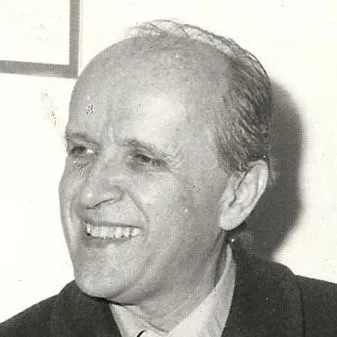
Biography
Nino Rota (1911–1979) was born into a musical family and quickly revealed himself as a child prodigy, beginning to compose at the age of eight. He received his formal musical education at several institutions, including the Milan Conservatory. At the age of twenty he traveled to the United States, where he studied composition at the Curtis Institute of Music in Philadelphia.
After returning to Italy, Rota broadened his intellectual training by earning a degree in literature from the University of Milan. In 1937 he began teaching, and in 1950 he was appointed director of the Bari Conservatory, a post he held until his death in 1979. Alongside his academic career, he maintained a remarkably prolific output as a composer.
Rota is best known internationally for his film scores, particularly his long-standing collaboration with Federico Fellini, which produced such landmark films as La strada, La dolce vita, and 8½. He also composed the music for The Godfather trilogy, as well as for films by Franco Zeffirelli, including Romeo and Juliet (1968) and The Taming of the Shrew. His score for The Godfather Part II earned him the Academy Award for Best Original Score; thematic material from the first two films was later reused posthumously in The Godfather Part III.
One of Rota’s most widely recognized melodies is the love theme from Romeo and Juliet, often known as A Time for Us, which achieved worldwide popularity. The most successful American release was an instrumental version by Henry Mancini, which reached number one on the U.S. charts in 1969.
Beyond his work for cinema, Rota composed extensively for the concert hall and the stage, writing symphonic works, chamber music, ballets, and operas. His 1977 opera The Italian Straw Hat was presented by the Santa Fe Opera, affirming his standing not only as a film composer but as a versatile and accomplished figure within twentieth-century classical music.