Biography
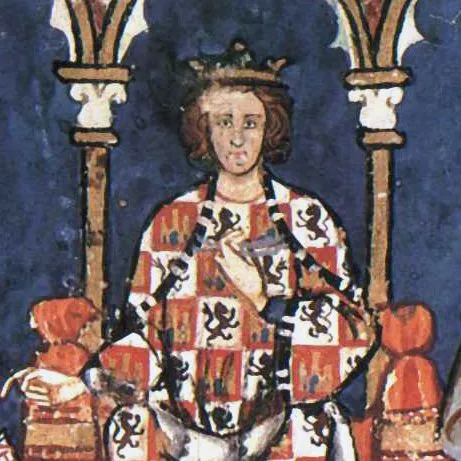
Alfonso X of Castile stands as one of the most intellectually ambitious monarchs of medieval Europe. Reigning during a formative period of Iberian history, he sought not only to rule territory but to systematize knowledge, law, language, and culture itself. His reign (1252–1284) fused political ambition with encyclopedic scholarship, leaving a legacy that far outstripped his mixed success as a statesman.
Early Life and Formation (1221–1252)
Alfonso was born in 1221 in Kingdom of Toledo, the eldest son of Ferdinand III, king of Kingdom of Castile and Kingdom of León. His mother, Beatrice of Swabia, was related to the imperial Hohenstaufen dynasty, a connection that would later fuel Alfonso’s imperial ambitions.
Raised at a court that blended Christian, Jewish, and Islamic traditions, Alfonso received an unusually broad education for a medieval prince. He was fluent in Latin and familiar with Arabic learning traditions, and he developed early interests in astronomy, law, poetry, and history. From his youth, he accompanied his father on military campaigns during the Reconquista, gaining practical experience in governance and warfare.
Accession and Political Context (1252)
When Ferdinand III died in 1252, Alfonso inherited a vast and recently expanded realm. The Reconquista had delivered major southern cities—especially Seville—into Christian hands, but these territories were culturally diverse and administratively fragile.
Alfonso’s central challenge was consolidation: binding together Castile, León, and Andalusian conquests under a coherent legal and fiscal system while maintaining the loyalty of powerful nobles and municipalities.
King and Legislator: The Siete Partidas
Alfonso’s most enduring political achievement was legal rather than military. Under his direction, scholars compiled the Siete Partidas, a comprehensive law code intended to rationalize governance across the kingdom.
The Partidas covered:
Constitutional theory (the nature of kingship)
Civil and criminal law
Church law
Commercial regulation
Family and inheritance law
Drawing on Roman law, canon law, and Iberian custom, the work articulated a vision of the king as supreme legislator ruling under law rather than mere feudal tradition. Though resisted during Alfonso’s lifetime, the Siete Partidas later became foundational to Spanish law and, centuries later, influenced legal systems in the Americas.
Cultural Program and the “School of Translators”
Alfonso transformed Toledo into the intellectual capital of western Europe. Building on earlier translation movements, he patronized a multilingual scholarly enterprise—often called the School of Translators of Toledo—where Jewish, Muslim, and Christian scholars collaborated.
Under Alfonso’s supervision, works on:
Astronomy
Medicine
Philosophy
History
Mathematics
were translated from Arabic and Latin into Castilian, which Alfonso deliberately promoted as a language of scholarship and governance rather than limiting learning to Latin.
This linguistic policy helped establish Castilian Spanish as the basis of the modern Spanish language.
Astronomy, Science, and the Alfonsine Tables
Alfonso was personally fascinated by astronomy and cosmology. His court produced the Alfonsine Tables, highly influential astronomical charts based on Islamic scientific traditions but adapted for European use. These tables remained authoritative for centuries and were used by astronomers well into the Renaissance.
Legend has it that Alfonso once remarked that, had God consulted him at Creation, he might have suggested improvements to the cosmos—an anecdote reflecting both his intellectual confidence and the suspicions his learning sometimes aroused.
Poetry and Music: Cantigas de Santa Maria
Alfonso was not merely a patron but a participant in artistic creation. He is closely associated with the Cantigas de Santa Maria, a monumental collection of over 400 devotional songs written in Galician-Portuguese.
The Cantigas:
Celebrate miracles of the Virgin Mary
Preserve medieval musical notation
Provide rare visual depictions of 13th-century life
They remain among the most important musical and literary sources of medieval Europe.
Imperial Ambitions and Foreign Policy
Leveraging his maternal lineage, Alfonso claimed the title of Holy Roman Emperor after the death of Frederick II. Though elected by some German princes, Alfonso never secured papal coronation nor traveled to Germany to enforce his claim.
The pursuit drained royal finances and alienated Castilian nobles, contributing to internal instability without tangible reward.
Military Affairs and the Reconquista
Militarily, Alfonso’s reign was uneven. He suffered setbacks against the Nasrid Kingdom of Granada, including a significant defeat at Écija (1275). While he maintained territorial integrity, he lacked his father’s battlefield success and increasingly relied on diplomacy and tribute rather than conquest.
Internal Crisis and Dynastic Conflict
The latter years of Alfonso’s reign were marred by rebellion. After the death of his eldest son, Ferdinand de la Cerda, a succession dispute erupted between Alfonso’s grandsons and his second son, Sancho.
Much of the nobility sided with Sancho, leading to civil war. Alfonso retained only limited control near the end of his life and was effectively sidelined politically.
Death and Burial (1284)
Alfonso X died on April 4, 1284, in Seville, embittered but intellectually unrepentant. He was buried in Seville Cathedral alongside his father.
Legacy and Historical Assessment
Alfonso X is remembered less as a successful ruler than as a transformational cultural architect.
His lasting contributions include:
Codifying law in the vernacular
Institutionalizing Castilian as a language of knowledge
Preserving and transmitting Arabic science to Europe
Creating foundational works of medieval music and historiography
While his political authority weakened, his intellectual vision endured. Modern historians often describe Alfonso as a ruler ahead of his time—one whose conception of kingship was scholarly, rational, and cultural rather than purely feudal or military.
In this sense, El Sabio did not merely reign over Castile; he attempted to reign over knowledge itself.